From the BALANCE of the Body!
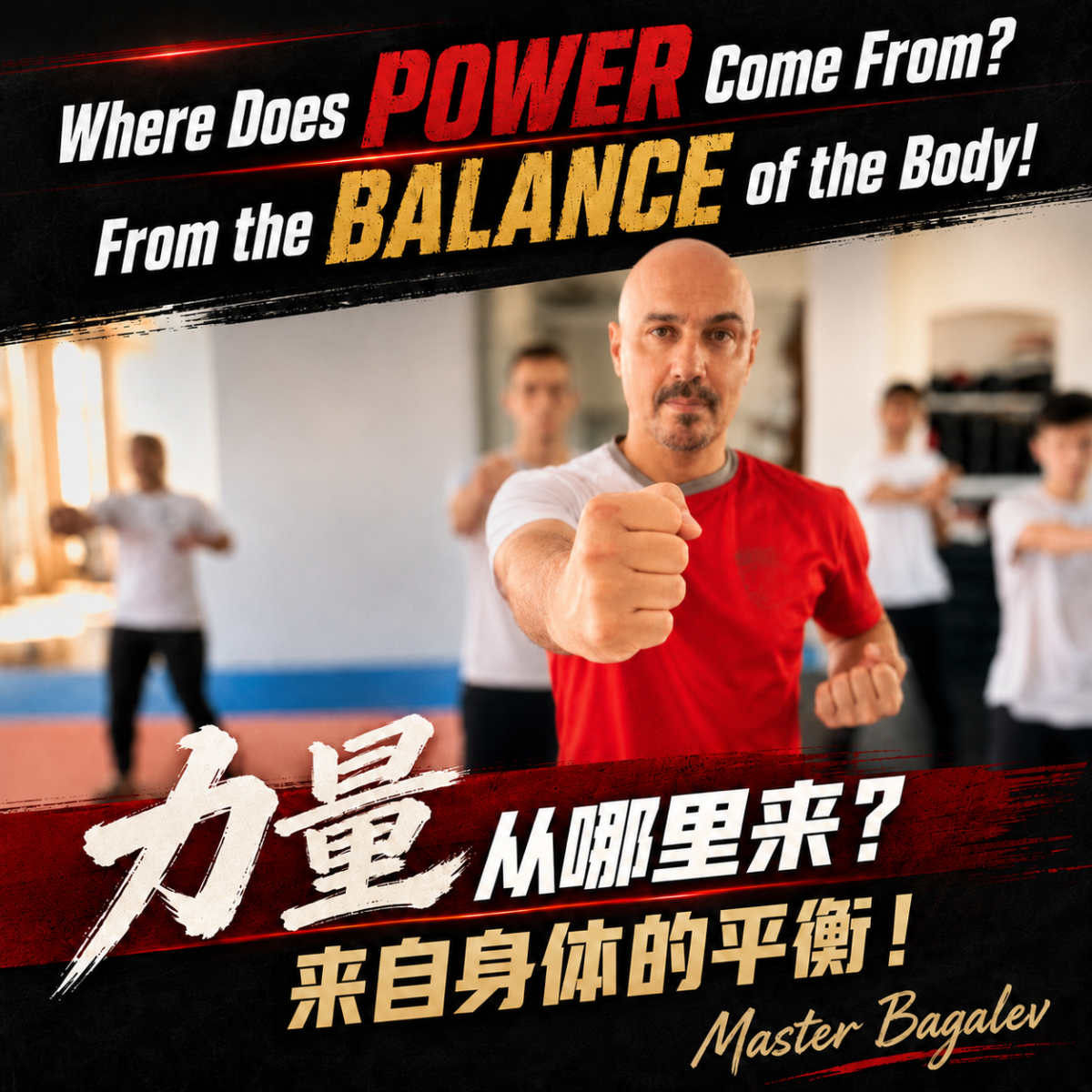
Power does not come only from the muscles.
True power comes from correct structure, from balance, from the connection between the ground, the body, the center, and the intention.
In WingChun 詠春拳 / 永春拳 — WingChun / WingTsun — power is not understood only as physical effort. It is the result of a correctly organized body, a stable center, a relaxed but alive structure, and the ability to transmit power in the right direction.
When the body is not in balance, when the spine is not properly aligned, when the weight is not in the middle of the foot but falls back into the heels or forward into the toes; when the lower back is “broken” backward, when the chest is closed, or when the head is too far forward — then the body begins to compensate.
One muscular chain becomes too tense, another one relaxes too much. One part of the body tries to hold the balance, while another loses connection. In this way, instead of free movement, we get tension. Instead of power — effort. Instead of structure — compensation.
That is why in WingChun we speak about body structure — 身形 San Ying / Shēn Xíng — and about the centerline — 中線 Jung Sin / Zhōng Xiàn.
When the body is organized around the center, power can pass through it without unnecessary tension.
This can easily be seen by the eye of a specialist. But the most important thing is the test — physical, direct, and practical. The real check comes when there is pushing, pulling, pressure, striking, changing of direction, and contact with a partner. Then it immediately becomes clear whether we are correctly positioned, or whether we only think that we are stable.
Theory Is Part of Training
THEORY is a very important element of training, because without knowledge there is no true practice.
That is why it is necessary to share clearly explained theory with the students — an idea of biomechanics, visual demonstration, and visualization. The body must not only repeat movements. It must also understand why it is doing them.
In Chinese martial arts, we often speak about:
身法 San Fat / Shēn Fǎ — body method;
步法 Bou Fat / Bù Fǎ — footwork method;
手法 Sau Fat / Shǒu Fǎ — hand method;
力 Lik / Lì — strength, power;
勁 Ging / Jìn — internal, structured, directed power;
意 Yi / Yì — intention;
氣 Hei / Qì — vital energy, breath, inner vitality.
When the body, the steps, the hands, the breathing, and the intention work together, then power is no longer rough. It becomes whole, directed, and effective.
Four Models of Training
EXERCISES FOR BODY STRUCTURE, BALANCE, AND POWER DEVELOPMENT are important for all levels of WingChun practitioners — whether you are a beginner, intermediate, advanced student, or instructor.
That is why in our teaching we have four main models of training.
First Model: Solo Exercises
We begin with the first model — solo exercises.
The training of the form — 套路 Tou Lou / Tào Lù — is a sequence of fixed movements. But inside it there is something very important and often invisible, something that not everyone trains consciously: the position of the body, the torso, the pelvis, the chest, and the head.
In WingChun, the first form 小念頭 Siu Nim Tau / Xiǎo Niàn Tóu — “The Little Idea” — is not simply a form for the hands. It is a laboratory for structure, balance, center, and inner organization.
There we consciously train dynamic balance, without anyone disturbing us — while in reality we are disturbing ourselves, because we still do not understand the deep connection between the fascial chains: central, front, back, lateral, and diagonal.
The body must learn to stand alive, but not tense.
Stable, but not stiff.
Relaxed, but not weak.
Ready, but not nervous.
Solo exercises also include punches, combinations, walking, steps, turning, changes of direction, and finally — free shadow fighting.
Here the practitioner begins to understand his own body.
And the one who does not understand his own body will have difficulty understanding the body of the opponent.
Second Model: Partner Exercises
We continue with the second model — partner exercises.
They give us the real test of the dynamic change of balance in time and space. Because the human being is not a frozen, unchanging structure. We are a variable, dynamically changing structure in time and space.
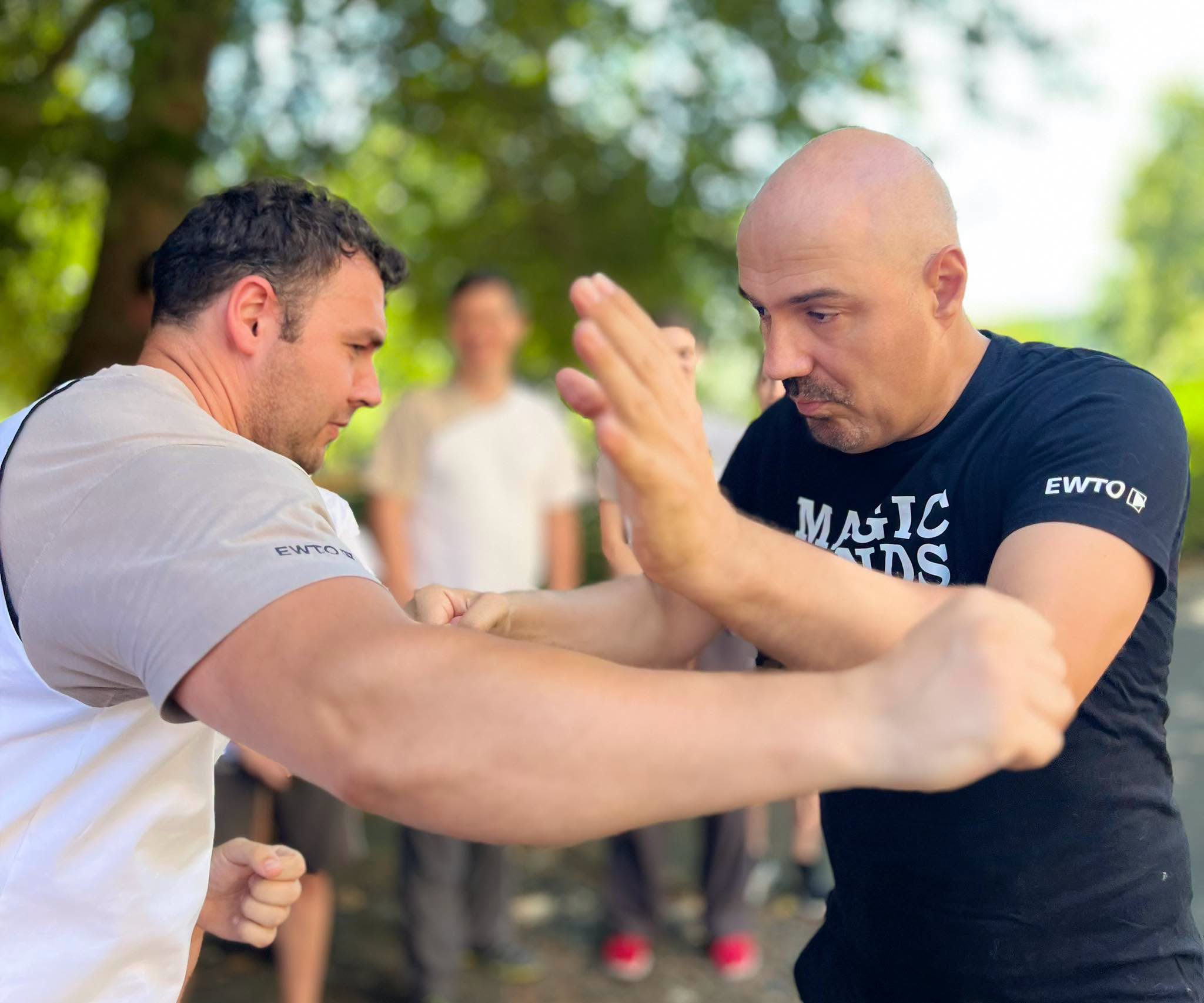
When working with a partner, we understand whether we can keep our center when the other person pushes us, pulls us, attacks us, changes direction, enters the distance, or leaves it.
Here appears the principle of 黐手 Chi Sau / Chī Shǒu — “sticky hands.”
But Chi Sau is not a game with the hands. It is training for feeling, structure, center, pressure, relaxation, leading, and following.
In WingChun there are also important principles:
來留 Loi Lau / Lái Liú — what comes, receive;
去送 Hoi Sung / Qù Sòng — what goes, follow;
甩手直衝 Lat Sau Jik Chung / Shuǎi Shǒu Zhí Chōng — if the way is free, enter directly.
Partner exercises are organized according to the three distances — long, middle, and close. They include attacks on a straight line, on an arc, and in a circle; attacks to the upper, middle, and lower part of the body; work against one opponent, against more than one opponent, and also against weapons — striking and cutting weapons.
Here we no longer train only position — we train change.
Not only stability — we train adaptation.
Third Model: Punching, Not Pushing
The third model is PUNCHING, not pushing.
As Bruce Lee said:
Don’t push — punch!
Pushing is not striking. Pulling is not cutting. Contact is not control. Power is not tension.
In WingChun, the strike must have structure, direction, density, and intention. This is connected with the concept of 發勁 Fat Ging / Fā Jìn — releasing power.
There are several important elements of striking power:
the initial condition of the body; the position of the striking surface; the direction of the strike; the density of the power; the speed of the strike; the connection with the ground;
clear intention — 意 Yi / Yì.
In the beginning, the strike is trained without a big change of direction, density, or speed — slowly and correctly. Then at medium speed. Then fast.
Only after that do we introduce changes of direction during the strike, changes in density, changes in speed, and adaptation to the movement of the partner.
That is why the training programs include exercises that develop:
the individual feeling of the body; the feeling of the opponent’s body; following and leading;
control of distance; striking with correct direction, density, and speed; the ability for power to pass through the structure, instead of being lost in tension.
The strike does not begin from the fist. It begins from the ground, passes through the structure, and is guided by intention.
Fourth Model: Stress Training
The fourth model is STRESS TRAINING.
Stress training develops our reaction under pressure. Because in a real situation the psyche often screams:
Stop. Freeze.Tense up. Run. Get away.
But sometimes we must stay there, act, and defend ourselves. Then we must master the psyche, so that the spirit can lead the body.
In the Chinese tradition, we can speak about 心 Sam / Xīn — heart, mind, spirit.
And also about 神 San / Shén — spirit, presence, inner alertness.
When fear controls the body, the movements fall apart.
When the spirit leads the body, the structure remains alive.
Stress training is an important part of the training model, because before it we must already have created stability of the body, a clear connection with the partner, control of defense, and the ability to strike.
Then comes the time to test what we have learned under stress, speed, and power. Exactly there we will understand what we can truly do.
If we meet a problem, we do not lie to ourselves. We do not make excuses. We simply go one step back and train more.
True Power
True power is not only in the muscle. It is in the balance. In the structure. In the center. In the intention. In the ability to remain calm under pressure.
In WingTsun, power comes from the correct body, the correct mind, and the correct direction.
And then technique is no longer just movement.
It becomes the expression of the whole body.
Power without balance is tension. Balance without intention is a pose. Intention without structure is only desire.
But when balance, structure, intention, and spirit come together — then true power is born.
Stanislav Bagalev
2026
#ewto #bulgaria #masterbagalev #wingtsun #ewtobulgaria #wingchun #詠春 #永春 #chinesemartialarts #selfdefence #kungfu #chisau #siunimtau