Football and the Martial Arts
Whenever the World Cup takes place, the whole world becomes football.
And yet, perhaps not only then, because football is everywhere and exists at all times. It moves millions of people, creates legends, sets character against character, and reveals how important strategy, timing, energy, and the will to win truly are.
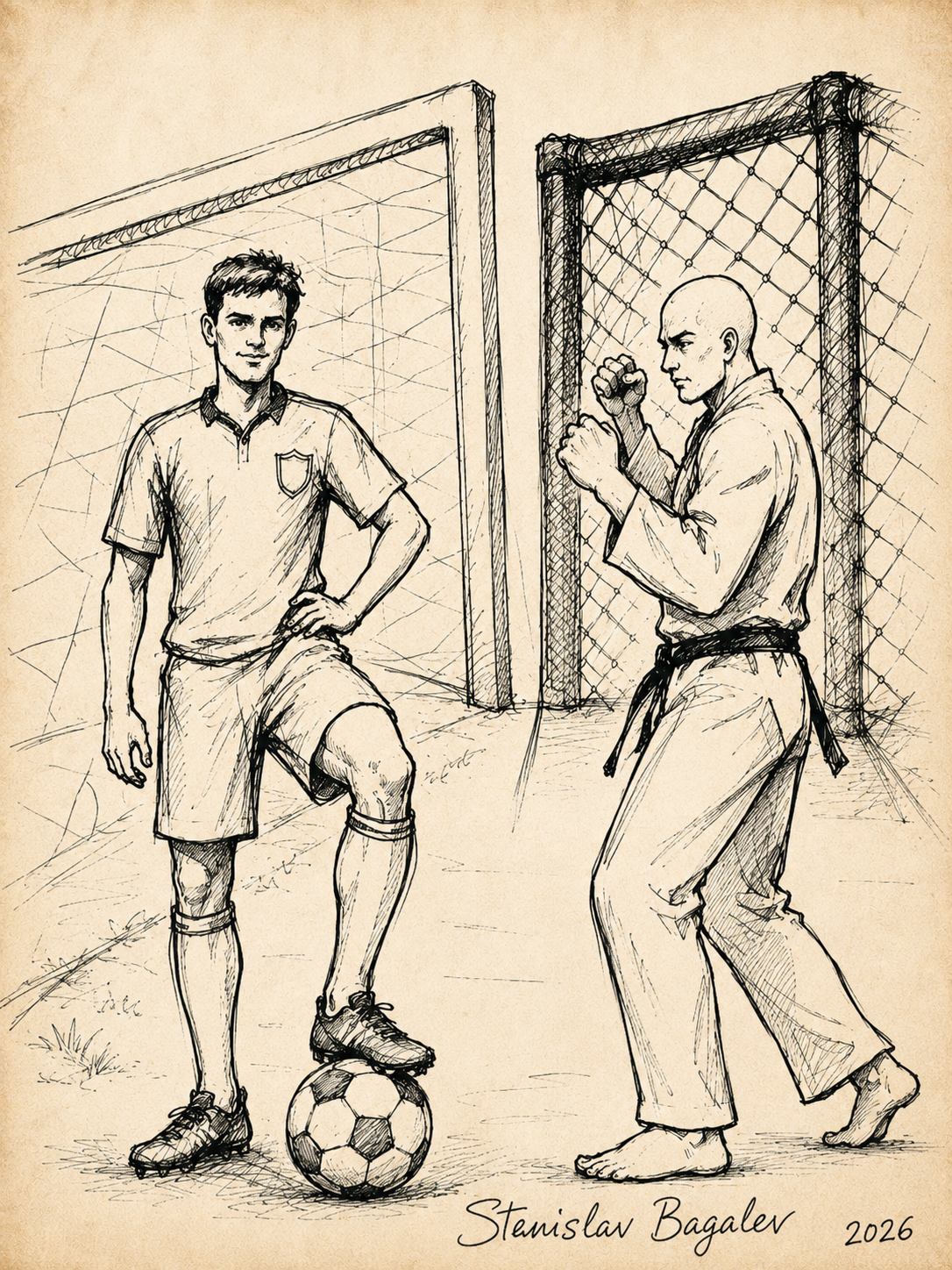
Let us make a contemporary comparison between football and the martial arts.
As we all know, there are strong football teams and weak football teams. But there are also extraordinary teams and extraordinary players who change the game forever.
The same is true in the martial arts. There are exceptional masters, but there are also many weak ones. There are stars and champions who rise in the firmament and transform the world of martial arts.
What do these two worlds have in common?
Far more than may appear at first sight.
Distance in Football and the Martial Arts
A football field can be divided, in principle, into three areas:
- our own half;
- the middle of the field;
- the opponent’s half.
In the same way, space in the martial arts can also be divided into three distances:
- close distance — the space immediately around our own body;
- middle distance — the space between ourselves and the opponent;
- long distance — the space within reach of the opponent’s body and head, where our attack must arrive.
Whoever controls all distances is the king of the field — both in football and in the martial arts.
If, in football, you retreat entirely into defence and remain waiting in front of your own goal, the probability that your opponent will eventually score is very high.
In the same way, if in combat you remain trapped in a closed defensive shell and expect only to protect yourself from the opponent’s strikes, sooner or later the probability of being hit and knocked out becomes very high.
If you play only in midfield, without truly attacking or defending, the opponent will surprise you and score. Of course, there is a slight possibility that you may kick the ball from the centre and, if the goalkeeper is out of position, score by chance. But that is not strategy. It is coincidence.
The same applies in the martial arts. If your hands remain only at middle distance, but you fail to protect the close and rear line leading to your head, you will be struck.
If you play only forward, in constant attack, but have no midfield and no defensive line, there is certainly a possibility that you may score. Yet if you miss only one pass, the other team immediately begins its attack, and you have already lost control of the field.
The same is true in combat. If you rely only on your attacks but do not protect your head and body, you may win by chance. But the danger of being struck and knocked out remains very great.
Therefore, the person who controls distance in football controls the field.
And the person who controls distance in combat controls the fight itself and its outcome.
You must have defence, midfield, and attack. You must continuously observe where an opportunity opens and where it closes.
You must become like water — entering wherever space is free and placing barriers wherever an attack may come from.
In football, we play across three fields: our own half, the middle, and the area in front of the opponent’s goal.
In combat, we also play across three fields: we protect our own space, control the middle distance, and attack the opponent’s body and head.
Timing — Being at the Right Moment in Football and the Martial Arts
Timing is everything in life.
If you are late, events have already taken place without you.
If you are on time, you participate in the situation.
If you are slightly ahead of it, you gain the advantage of deciding, choosing, and even determining what will happen.
Timing in football is of enormous importance.
If you merely wait to see what will happen on the field but fail to react, you will always be after the pass, after the shot, and after the goal. At that point, you are no longer directing the game. You are merely trying to catch up with the result.
Timing is equally important in the martial arts.
If you are not attentive, if you are not truly present in the situation, and if you wait first to see the attack before beginning to react, you will always be behind the strike. In that case, defeat is more than obvious.
When you are on time in football, you are inside the game. You understand what is happening, you see the changing situations, and you respond appropriately. You are where you must be, at the moment when you must be there, and you begin to lead the game.
In the martial arts, to be on time means to be here and now.
Then you can see and feel the attacks, respond properly to the opponent’s defence, and protect yourself from the strikes.
But to be slightly ahead of the situation — that is already a higher skill.
In football, the great players do not merely see what is happening. They see what is about to happen. They sense the situation before it fully develops and begin to create it themselves.
They have already taken the correct position before the defender understands in which direction the attack will move. For the other player, the situation is only beginning. For the true master, it has already been decided.
In the martial arts, to be before the opponent, before his attack, and before his strike is a great level of mastery.
To end the danger before the attack has fully unfolded — this is the master’s ability to read timing.
We must therefore learn to control time:
- to be before the situation;
- to be together with the situation;
- and even when we are slightly behind it, to recover control and still emerge victorious.
Energy in Action
Another essential factor is the energy we invest in action.
Energy may be:
- small and soft — Yin;
- powerful and explosive — Yang;
- moderate and balanced — a union of Yin and Yang.
In football, energy is everything.
If you have energy in the first half but none in the second, you may still lose the match.
If you play too passively when the situation demands activity, you lose the initiative.
If you become overexcited and decide that you are so strong that you can play at maximum intensity without pause, sooner or later you will break down. Neither the body nor the mind can remain permanently under extreme tension.
Energy has the same significance in the martial arts.
If you begin too strongly, you may win the first points or even the first round. But if you cannot endure physically and mentally in the later rounds, you may lose heavily.
When the energy is full, moderate, and continuous, there is control. There is timing, coverage, defence, and attack.
But in order to create surprise, something must change at the right moment.
There must be a sudden entry, a change of rhythm, and an unexpected attack capable of producing victory.
Tactically, we may use soft Yin energy for a long time. We may pretend to retreat in order to provoke the opponent’s attack.
We may maintain a steady rhythm and then suddenly break it.
We may hide in order to appear.
We may open in order to close the trap.
We may retreat in order to enter.
This is the interplay of Yin and Yang — softness and hardness, emptiness and fullness, calmness and explosion.
The Will to Win
Desire and will determine many things even before they have begun.
When you have already won within yourself, when your will is strong and you know that you will not surrender, then the energy with which you play and fight becomes entirely different.
It can be felt.
It can be seen.
When a team enters the field merely to get through the match, to survive the half, and to wait for the end, its spirit has already fallen. There is no real desire to play, no true presence, and no will to win.
It is the same in combat.
When you enter with the thought that the person before you is better and that you have no chance of winning, you have already surrendered before the fight has even begun.
When you enter with the will to win, when you want victory and know how to achieve it, your will becomes dense, visible, and tangible.
Then you play to win.
You possess the spirit required for battle.
But when you enter with such a powerful will that the victory has already taken place within you, and all that remains is to materialise it — this is the mindset of the greatest.
The true master does not rush.
He waits.
He feels.
He sees.
And at exactly the right moment, he strikes, passes, scores, or delivers the decisive blow.
This is not trained only physically.
It is built mentally — through inner state, energy, confidence, and will.
The Four Fundamental Principles
Here are the four main ideas — distance, timing, energy, and will — together with their different expressions:
| Principle | Yin — Receding State | Balance — Controlling State | Yang — Leading State |
|---|---|---|---|
| Distance | Close distance | Middle distance | Long distance |
| Timing | After the situation | Together with the situation | Before the situation |
| Energy | Weak, soft energy | Moderate, balanced energy | Strong, explosive energy |
| Will | Weak will | Will to win | Unshakable will to win |
These states should not be understood as something fixed.
Mastery lies in the ability to move freely between them according to the situation.
Sometimes we must be close. Sometimes we must remain in the middle. Sometimes we must reach the distant target.
Sometimes we are behind the situation. Sometimes we move together with it. And sometimes we must be ahead of it.
Sometimes the energy must be soft, at other times balanced, and at the precise moment, explosive.
The will must also grow — from hesitation, through the desire for victory, to the unshakable inner certainty that victory is possible.
Football as a Martial Art
This is why the connection between football and the martial arts is so close, so obvious, and so visible — for those who have eyes to see it.
In both worlds, you must control space.
You must govern time.
You must distribute your energy.
You must possess the will to win.
The difference lies only in the means.
In football, the ball enters the goal.
In the martial arts, the strike reaches the target.
But the principles that govern victory are the same.
Watch the Hong Kong film Shaolin Soccer, directed by Stephen Chow, who also plays the leading role. In it, the relationship between kung fu and football is presented in a unique, humorous, and unforgettable way. Everything discussed here — distance, timing, energy, will, and martial strategy — can be seen on the screen.
July 2026
Master Stanislav Bagalev