The Sword Hand, Tegatana — てがたな, Shǒudāo 手刀, and the Eight Slashing Knives Baat Cham Dao 八斬刀
The mystical idea of the sword hand has always been part of the world of martial arts.
But what lies behind this secret idea?
“Power is born in the feet and legs, directed by the pelvis and waist, and expressed through the hands…”
This is a classic principle in martial arts theory.
But how can the hand become stable and strong in attack, in defense, and in the guidance of force?
The Position of the Hand
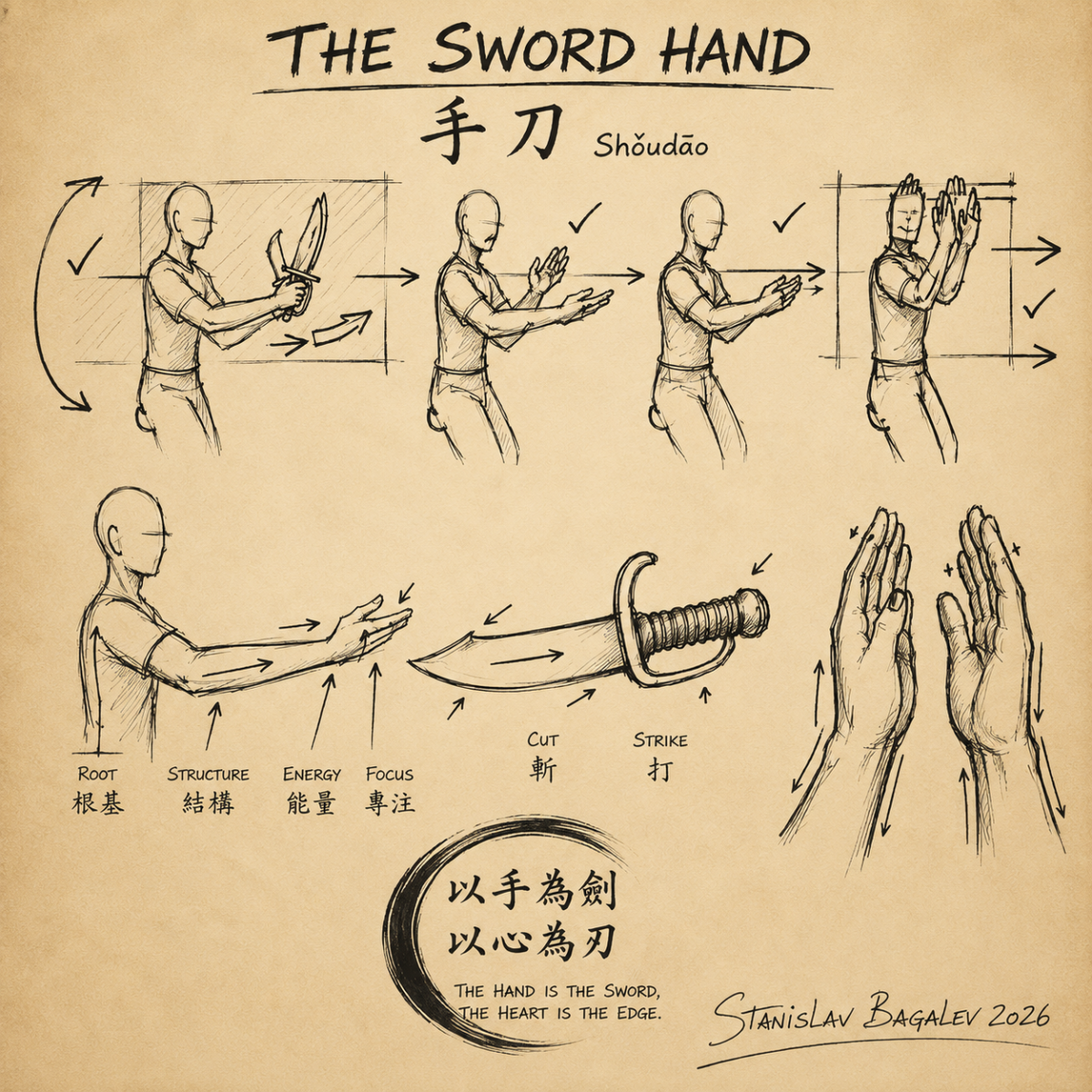
In WingChun, the hands are often placed in front of the body, with one hand facing forward, palm out, while the other stays behind it, palm facing upward.
This is a common image of the traditional WingChun position. But why is it like this?
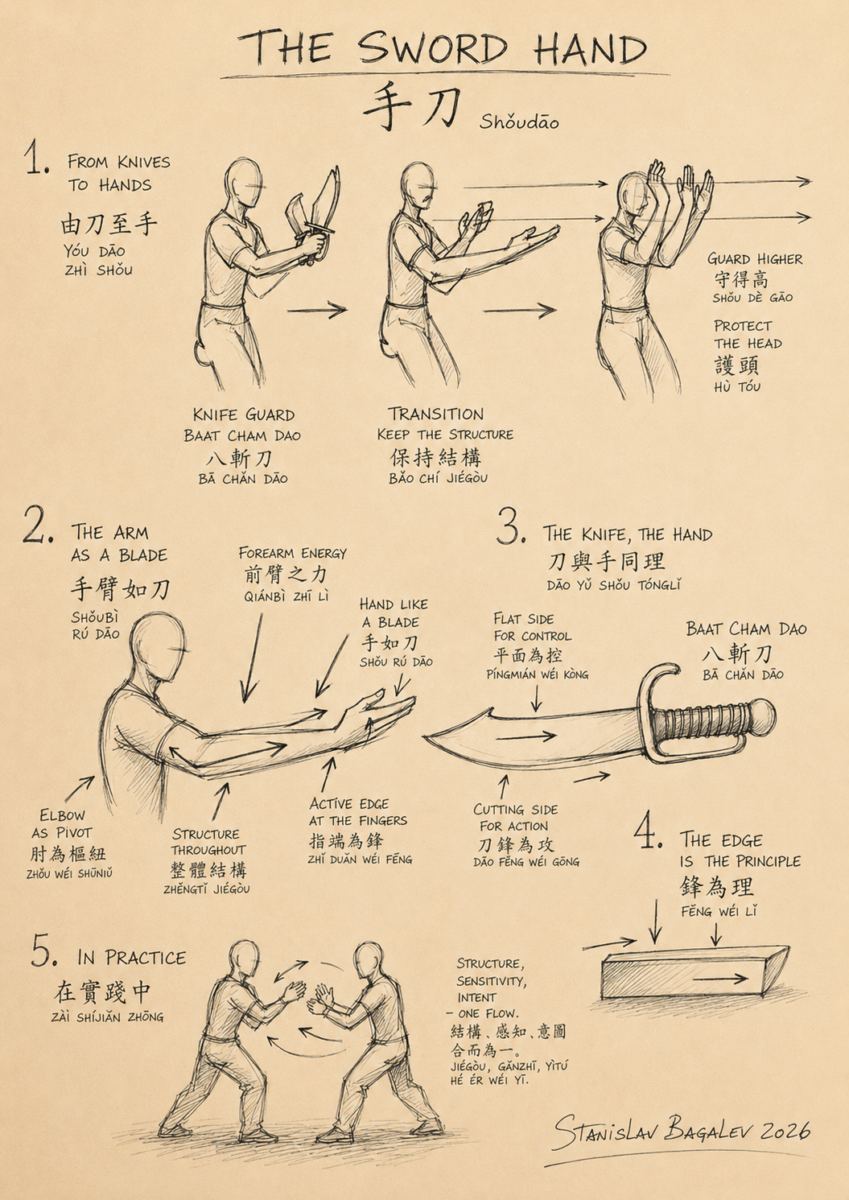
Because this is the position of the hands when they are supposed to hold two swords — 八斬刀 — Baat Cham Dao, or two knives. They cover the upper part of the body, while the blades reach up to the top of the head. In this way, the upper part of the body is protected against weapon attacks aimed at the head.
This is a normal position when we actually have weapons in our hands, especially two of them.
But when we do not have weapons in our hands — should we still keep our hands in the same position?
Definitely not!
Because then the head remains open to attack, and we can easily be hit.
What is the purpose of the hands? To protect the head and the upper part of the body.
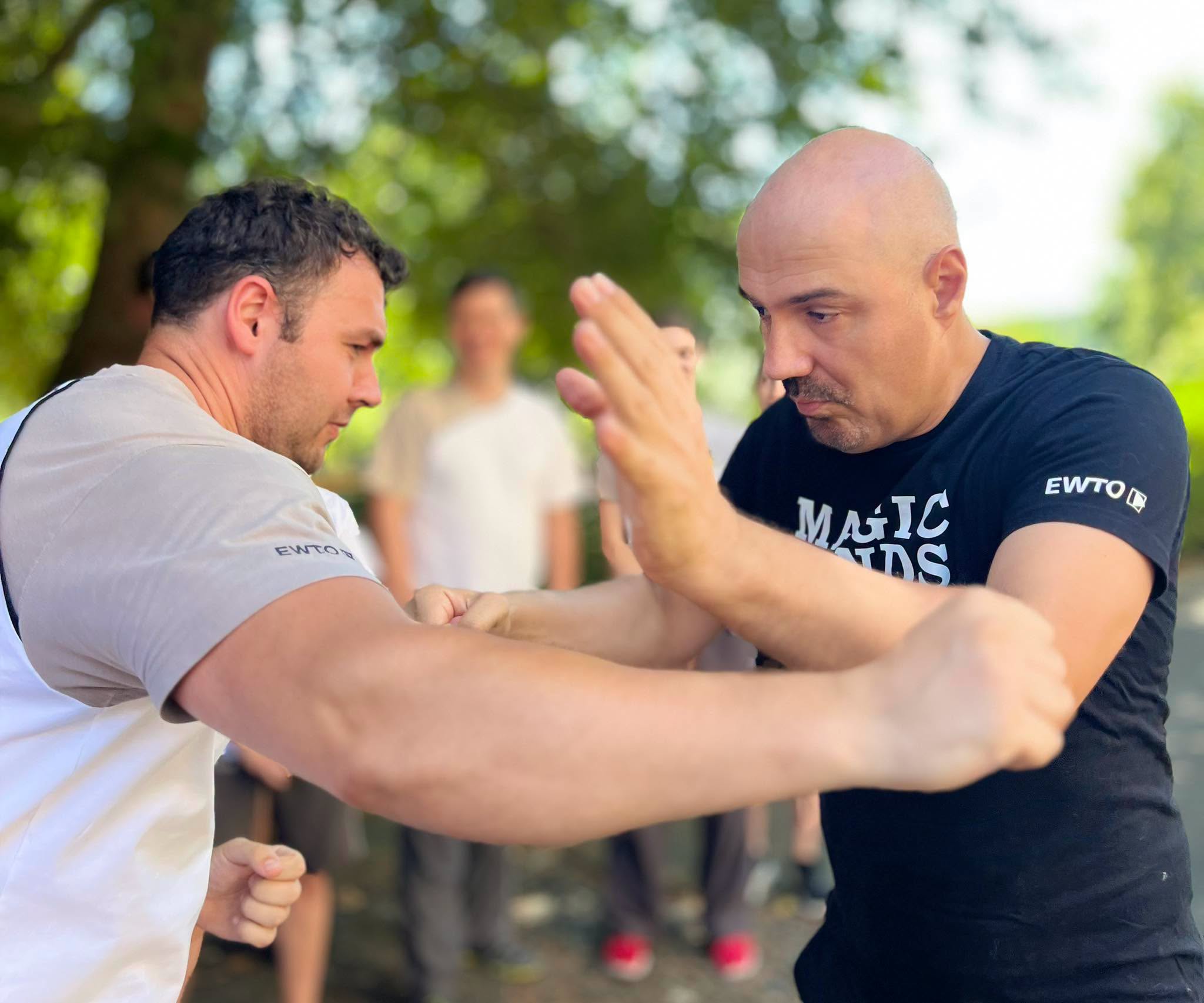
Therefore, in WingChun, when we do not have weapons in our hands, the position of the hands should be much higher. The palms should cover and protect the face, the base of the palm should be at jaw level, and the elbows should point downward in order to protect the torso down to the floating ribs.
This is an important change in the starting position, because traditionally the hands are held lower, imitating two swords. But when there are no swords in the hands, this is like pretending that you have a pistol in your hand when you do not actually have one. People will laugh at you.
So change the position of your hands, so that you do not get hit in the head!
The Energy of the Sword in the Hand
Many WingChun practitioners believe that their hands should be completely relaxed and soft. At the same time, however, their shoulders and back are often tense, which makes them immobile and very easy to attack.
The idea that the hands should be relaxed comes from the opposite idea — that the hands should not be stiff, clenched, or overloaded with muscular tension.
From this comes one of the main problems in traditional WingChun — the hands are held too low, and they are too relaxed. This leads to many problems, and often to being hit in the head.
I often say during training sessions and seminars:
Do not be the master of the soft sword!
That is why the energy of the hand, the energy in the forearm, in the palm, and in the fist must be a constant value. This is the background against which all actions later develop.
Initial power, energy, readiness, and connectedness — this is the key to strength and success.
The famous power of the elbow is in fact the activation of the forearm from the inside, the outside, the top, and the bottom.
Imagine the hand as a sword. A sword has two flat sides and two sharp sides. The same condition exists in our hand. The forearm has flat sides — inner and outer — and sharp sides — top and bottom.
The forearm must feel strong, yet mobile.
The palm must feel filled with energy from within — energy in the blade edge of the hand, in the fingers, in the line between the index finger and the thumb. In this way, the feeling of readiness, strength, and activity in the hand and forearm becomes complete.
I never cut with the flat side, and I never smear with the sharp side of the knife!
That is why all four sides of the sword hand must be active, so that one can react properly in attack, defense, guidance, and cutting.
Most people have a strong outer side of the arm, but the inner side of the forearm and palm are relaxed. This is incorrect, because it reduces the activity of the reaction.
I Strike — I Cut
These are the two important actions of the hand — from the elbow, through the forearm, to the palm and the fist.
Before the attack, the feeling of preliminary strength and preliminary readiness in the sword hand is very important. Otherwise, the movement becomes slow, soft, and ineffective.
When someone attacks us, we can meet the attack with the flat side of the hand — to receive it, deflect it, and control the opponent’s strike.
But we can also meet the attack with an attack — with the cutting side of the hand, from the inside or the outside, and cut through the attack, destroy it.
That is why the actions follow a clear principle.
First — we are ready with the complete feeling of active toughness in the hand even before we are struck. We have the correct position, the hands protect the head, and then we decide whether to attack the opponent or to attack his attacks.
Only then do we truly have a sword hand, a hand like a knife.
And this is also the main concept behind the WingChun knives — to have a ready hand that is like a sword, and not like a soft sword.
Why Do We Train with Weapons — Sword, Katana, WingChun Knives?
In the past, when there were no firearms, the sword was the king of weapons. But today, when pistols and modern weapons exist, why should we still train with swords and knives?
Because the feeling of the movement of the sword is important, so that later we can transfer it into the hand when we no longer have a sword.
This cannot be fully explained if a person has never trained with a sword. That is why, traditionally, all martial arts train with weapons.
In Aikido, people often speak about the line of the hand, the continuation of intention, and movement “like a blade.” This is the idea of Tegatana — てがたな — 手刀, “sword hand” or “hand like a sword.” In some schools, this is part of the beginning of every technique.
In Karate, the term shutō-uchi — 手刀打ち is often used, meaning a sword-hand strike or knife-hand strike, which is considered one of the most dangerous strikes.
In the Chinese martial arts, practitioners also train with the sabre — 刀 dāo, a slightly curved weapon sharpened on one side, and with the sword — 劍 / 剑 jiàn, a straight weapon sharpened on both sides. In Chinese, 手刀 — Shǒudāo means “knife hand,” “sabre hand,” or “blade hand.”
In WingChun, the weapon Baat Cham Dao — 八斬刀 / 八斩刀 is traditionally found. It is considered one of the most secret forms. It is often said that Ip Man did not show it to anyone, or almost no one. This is also supported by the fact that there is no video of Ip Man performing the form with the two knives.
Grandmaster Kernspecht possesses this form, and that is why there are so many variations in different lineages — because many people created their own versions, or passed it on in different ways.
The form Baat Cham Dao — 八斬刀 contains within it this entire concept of attack and cutting, of secret techniques and force that ends every attack.
But the form itself is not the most important thing.
What is important is the idea behind it — The Sword Hand!
July 2026
Master Bagalev