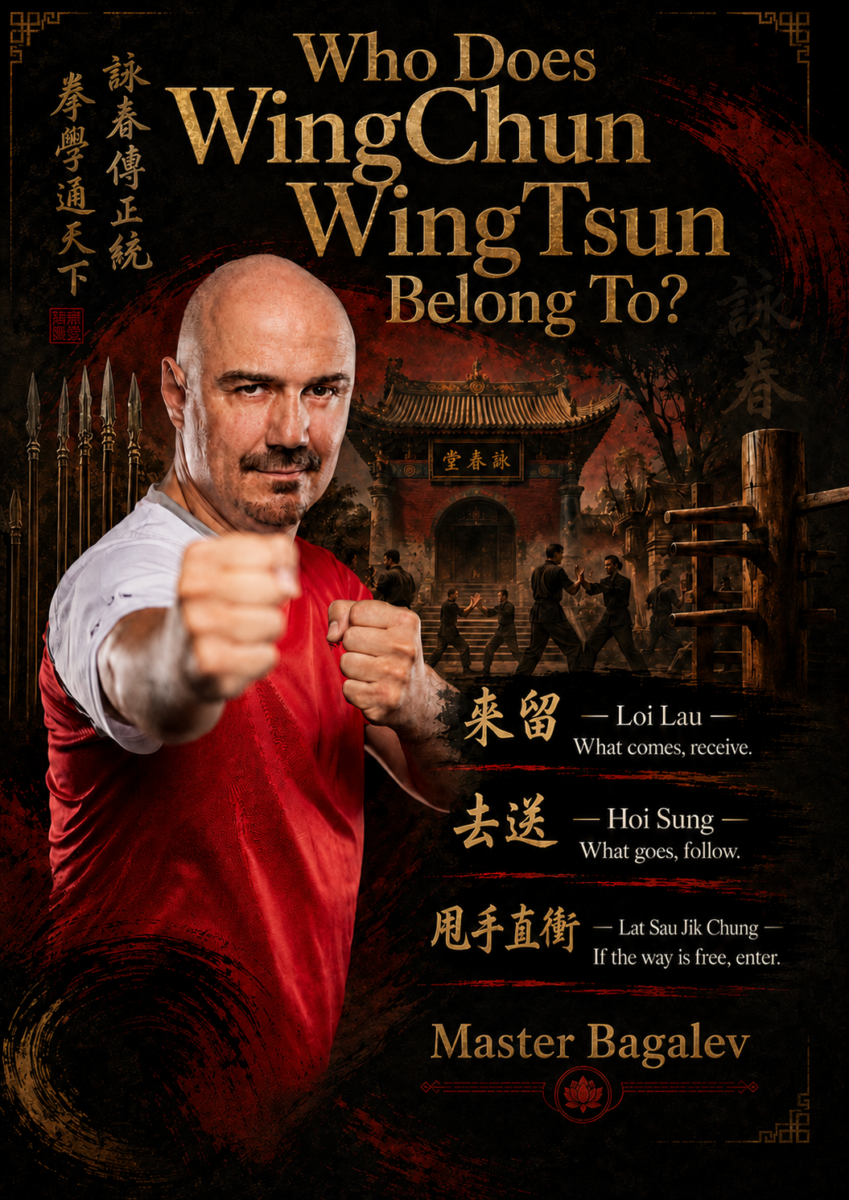
Principles, Understanding and the Living Tradition of WingChun, WingTsun
By Master Stanislav Bagalev
Very often, when two or more WingChun WingTsun practitioners meet, one of the first questions is: “Which system do you practice? Leung Ting? Wong? Chun? Kernspecht? Or another one?”
This is a natural human process — the separation between “ours” and “theirs,” between what is familiar and what is unknown, between “our lineage” and “your lineage.” From there, it is very easy to continue:
“We are more than you.” “We are right.” “You are wrong.” “Our WingChun is real.” “Your WingChun is not.”
And if the argument continues long enough, questions arise, then answers, then more questions, and finally someone says: “Let me see how you do it.”
And often, someone gets hurt.
But how can we truly define “our” WingChun and separate it from “their” WingTsun?
In reality, there is no division. There is only understanding and misunderstanding.
The Example of Mathematics
Let us take mathematics as an example.
One person may have studied in one school, another in a language school, a third in a mathematical high school, and another at a university. But does the fact that you studied with a certain teacher, professor, school or university give you the right to say:
“This is the mathematics of my teacher.” “This is the mathematics of my university.” “This mathematics is better than yours.”
No.
Mathematics belongs to everyone.
A good teacher may help you understand it better. A school may give you a stronger foundation. But there is no “our mathematics” and “your mathematics.” There is one mathematics, and the real difference lies in how deeply and correctly you understand it — and what level of problems you are able to solve.
The same is true for WingChun 詠春 / 咏春.
The WingChun of Yim Wing Chun 嚴詠春 was certainly not exactly the same as the WingChun of Leung Jan 梁贊.
The WingChun of Ip Man 葉問 was not exactly the same as that of Chan Wah Shun 陳華順.
The WingChun of Leung Ting 梁挺 and Wong Shun Leung 黃淳樑 was not exactly the same as that of Ip Man.
This is natural.
Every person changes the art according to their own body, mind, experience, understanding, previous training, physical structure, intellectual level, temperament, and even according to what they have read — or have not read.
WingChun WingTsun belongs to everyone.
But it must be understood as an art of ideas, concepts and principles — principles of movement, reaction, strategy, tactics, sensitivity, change and adaptation.
Is WingChun WingTsun Hard or Soft?
If WingChun is seen only as a hard, aggressive attacking system, based on forceful techniques and direct domination, then it begins to move toward the idea of external martial arts — 外家拳, Wàijiā Quán.
In such systems, one must be strong, tense, conditioned, able to receive blows, harden the bones, joints and muscles, and impose one technique against another technique, one angle against another angle, one force against another force.
There, the stronger, faster and more aggressive person often wins.
Many systems work according to this logic.
But is this truly WingChun?
Or is it only the outer form of WingChun, while the inner meaning has been replaced by hard, external ideas?
Perhaps someone understood the system in this way and changed it according to their own nature. Perhaps that person was strong, explosive, aggressive and fast, and the system worked for him in that way. But will the same approach work for another type of person?
Will it work for a smaller person? For an older person? For someone without great strength? For someone who cannot rely on speed forever?
This is where we must return to the principles.
The Three Original Chinese Ideas
In the WingChun WingTsun tradition, we often speak about the principles of fighting and the principles of force. At the root of many of them stand three short Chinese ideas:
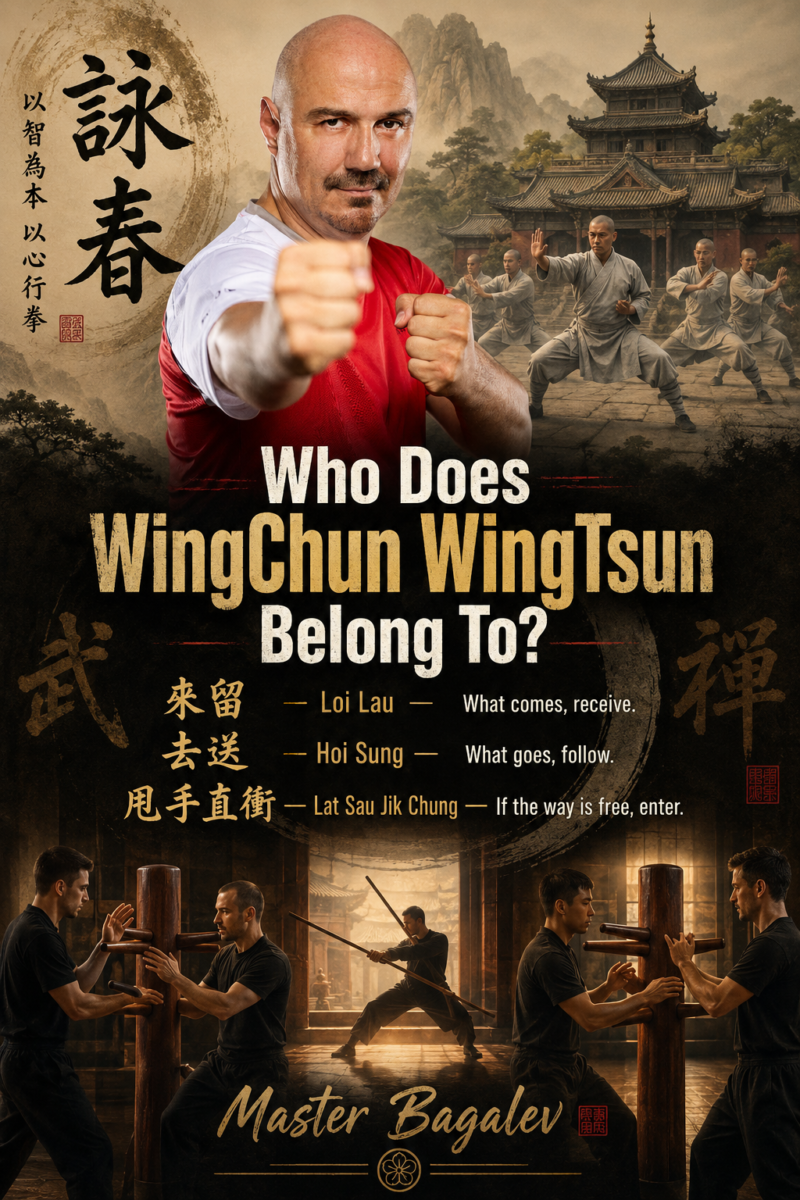
來留 — Loi Lau — When it comes, receive it / keep it.
去送 — Hoi Sung — When it goes, follow it / send it.
甩手直衝 — Lat Sau Jik Chung — When the hand is free, thrust forward.
These can be understood more clearly as:
What comes toward you — receive it.
What moves away — follow it.
If the way is free — enter.
Or, in a more practical expression:
If something comes toward you, take it and work with it.
If something moves away from you, follow it and do not lose it.
If the path is open, enter forward and do not stop.
From these ideas, the famous four fighting principles of WingChun were later formulated:
- If the way is free — attack.
- If contact is made — stick.
- If the opponent applies pressure — yield.
- If the opponent retreats — follow.
These principles are known in many WingTsun schools in Europe, especially through the teaching structure developed by Grandmaster Keith R. Kernspecht.
But why do the principles sometimes appear in a different order?
Because at a certain stage of teaching WingTsun in Europe, the system was presented as more aggressive, more direct, more powerful — a system of taking the central line and attacking until the opponent is completely overwhelmed. In this model, the last of the old Chinese ideas — “if the way is free, enter” — was placed first and became the main emphasis.
And the system worked.
It worked in a more aggressive, imposing and active way.
But if students do not also master the other side of the unity — softness, yielding, listening, following, receiving and transforming — they may remain only in the world of attack, hardness, muscles, pain and endurance.
Yin, Yang and the Center
The Chinese idea of Yin and Yang 陰陽 is not simply about two opposites. It is about two opposite qualities that form one whole.
But there is also a third condition — the middle, the transition, the neutral point, the center. It is the space between the two “fish” of the Yin-Yang symbol 太極圖, Tàijí Tú.
So we can speak of three aspects within one unity:
Yin 陰 — the receptive, yielding, hidden, soft aspect.
Yang 陽 — the active, expanding, visible, forceful aspect.
The center 中, Zhōng — the neutral, transforming, connecting state.
This is why, in WingChun, the number three appears again and again:
Three empty-hand forms.
Three major forms with weapons and training devices.
Three basic principles.
Three joints in the arms and legs.
Three Dan Tian 丹田 centers.
Three approaches to movement and reaction.
From here, we can understand three major approaches:
- From the center toward activity.
- From the center toward passivity.
- From activity or passivity back to the center.
And the combinations continue endlessly:
From activity through the center into new activity.
From passivity through the center into new passivity.
From activity into passivity and back into activity.
This is not a dead system.
It is a living process of change.
The Master Develops — The Teaching Develops
When the master develops, the teaching method also develops.
WingChun WingTsun itself does not change.
The person goes deeper. The person understands more. The person feels more. Because of that, the person changes — and the teaching around him changes too.
This is why, through the years, Grandmaster Kernspecht returned again and again to the original Chinese principles:
來留 — Loi Lau — What comes, receive.
去送 — Hoi Sung — What goes, follow.
甩手直衝 — Lat Sau Jik Chung — If the way is free, enter.
Each of these ideas must be studied deeply, not only repeated as a slogan.
That is why training methods for yielding, sensitivity and perception became more and more important — not only for the hands, but also for the legs, the body, the spine, the waist, the shoulders and the whole structure.
Every form trains a different principle of body movement.
This is why, in the old tradition, people said:
標指不出門 Biu Jee bat cheut mun “Biu Jee does not go outside the family.”
The third form, Biu Jee 標指, contains important ideas about circular and spiral energy, the movement of the body, the spine, the waist, the shoulder blades and the torso.
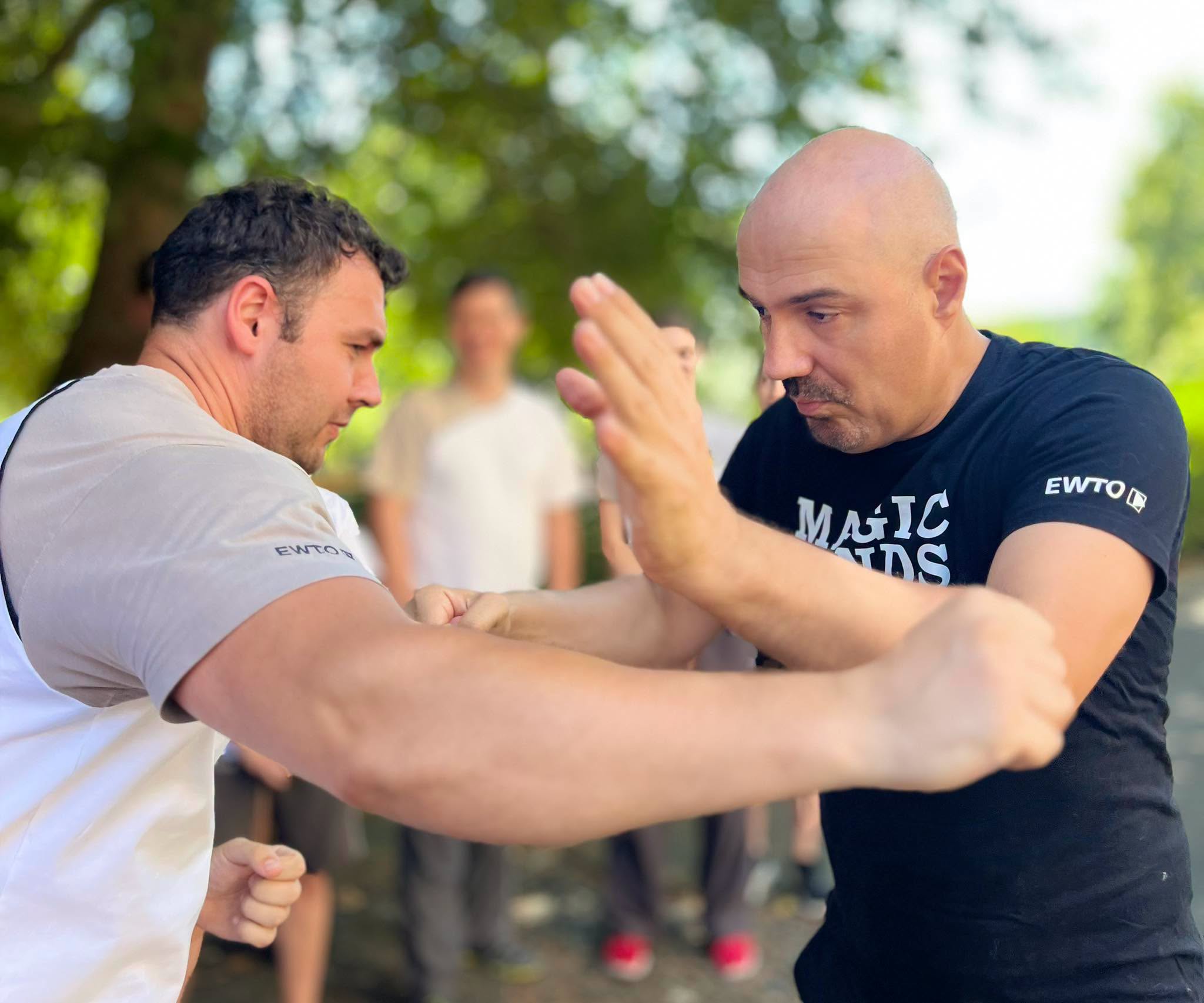
The torso and the head are a huge part of the whole body, yet many practitioners train mostly the arms and legs. But Chi Sau 黐手 — “sticking hands” — should not begin only from the hands. It should begin from the body toward the limbs, from the center toward the periphery.
The harder you are in the body, the more easily you can be controlled by the opponent’s force.
This is no accident. Wrestlers train the body deeply — not only the arms and legs — and their success proves the importance of this.
What Comes — Receive It 來留
The principle “what comes, receive it” does not mean to collide with the opponent’s force. It does not mean to block force with force or to push it away aggressively.
It means non-interference.
It means not changing the incoming movement unnecessarily. It means learning to forget the ego and follow the reality of the other person.
Through this principle, we learn to listen 聽勁, Ting Jin — to hear and feel force.
We learn to sense the opponent’s attack, position, pressure, intention and direction. We discover where, when and how much he presses or strikes. We discover where his open windows are and where we may enter.
This is a long and difficult process.
It cannot be achieved only through words.
What Goes — Follow It 去送
To train “what goes, follow it” means to learn how to follow carefully, without being noticed.
As Napoleon said:
“When the enemy is making a mistake, do not interrupt him.”
To follow is not easy.
You must forget your ego. You must not press simply because you want to dominate. You must not disconnect before the right moment. You must not change something that does not need to be changed.
This again requires correct training methods.
Words create intellectual understanding, but understanding is not yet doing.
Doing is not yet feeling.
Feeling is not yet real ability.
This is a process that must be observed by the teacher and followed by the student.
If the Way Is Free — Enter 甩手直衝
The third principle, “if the way is free, enter,” must also be understood carefully.
It does not mean to enter at any cost.
It means: enter only when the way is free.
Some practitioners try to create an opening through active techniques such as Pak Sau 拍手 or Lap Sau 拉手. This is one possible expression of the principle, but it is not the principle itself.
The principle says:
If it is free — enter.
This means that the attack should go where the opponent has no hand, no leg, no body, no barrier to stop us.
If there is an obstacle, we cannot simply attack through it with force and still claim to follow the principle. If we do so, we are breaking the principle.
Of course, if you are very strong, tall, muscular, aggressive and explosive, you may be able to break through. But what if you are not? What if you become older? What if the opponent is stronger?
WingChun follows the laws of nature.
If there is wind, the tree bends.
If there is a stone, the water flows around it.
If the water is strong enough, it carries the stone away.
So:
If you are strong — you may sweep through.
If you are not — you go around.
This is why Bruce Lee 李小龍 famously said: “Be like water, my friend.”
We are made mostly of water. So why do we try to become stones or dry trees?
Following the principle means that you do not collide with the opponent’s force. You absorb it, work with it, search for empty space and attack there. If needed, you go around and continue searching until the opportunity appears.
Tradition Without Understanding Is Not Enough
Unfortunately, some teachers and their methods remain fixed at the place where they began. Their students often follow them without realizing that they may no longer be training according to the real principles of the system.
It is like mathematics with only plus and minus.
Yes, for everyday life that may be enough.
But is that the whole of mathematics?
Or did the teacher simply never mention that something more exists?
We must search, think and experiment — not only follow and repeat.
Otherwise, we become machines. We may spend our whole lives shaping our bodies and reactions in a certain way, while never discovering the true path of development.
The Four Principles of Force
To continue the investigation, we must look at the four principles of force:
- Free yourself from your own force.
- Free yourself from the opponent’s force.
- Use the opponent’s force.
- Add your own force.
The first principle sounds very strange for a martial art:
Free yourself from your own force.
Usually, martial arts speak in the opposite way:
Become stronger.
Use more power.
Develop more force.
If you have no strength, you are weak.
But what do the Chinese traditions say about force?
They often distinguish between Li 力 — ordinary muscular strength — and Jin 勁 — refined, trained, internal force.
Li 力 is connected with the muscles. It has a beginning and an end, a clear direction, a point of contraction and relaxation.
Jin 勁 is different. It is more connected with tendons, fascia, elastic structure, spiral loading and whole-body connection. It is not simply tension and it is not simply relaxation. It is a living, elastic, changing power that can move in all directions.
Therefore, “free yourself from your own force” also means:
Free yourself from the force you already know.
Empty your cup.
Only then can something new be poured into it — a new feeling, a new understanding, a new quality of movement.
On a deeper level, it also means:
Free yourself from your ego.
Free yourself from your fixed ideas.
See things in another way.
If this does not exist as a training method, one must ask:
Am I really training WingChun WingTsun?
Or am I training an external style with WingChun movements on the surface?
Free Yourself from the Opponent’s Force
To free yourself from the opponent’s force is also not easy.
His force pursues you. Fear of being hit may paralyze you. This stopping makes you an even easier target.
To free yourself from something, you must first know it.
You must know where the force goes, how fast it moves, what direction it has, what intensity it carries, whether it is changing or fixed.
This is why exercises for sensitivity, sticking, following, yielding, manipulation, guiding, releasing and transferring are so important.
If these are missing from training, then a major hole appears in perception.
We do not perceive the world only visually. We also perceive it through feeling, pressure, rhythm and change.
Only when you free yourself from your own fear can you begin to free yourself from the other person’s force and aggression.
If not, the force catches you, presses you, crushes you, strikes you — and fear wins.
Training to collide with the opponent’s strike and harden your arms is not, according to the classical principles, the essence of WingChun. Yet this is becoming more and more common.
As Laozi 老子 reminds us, the replacement of essence with appearance is a danger that constantly surrounds us.
Do not follow others blindly.
Think with your own head.
Do not act without understanding.
Search — and you will find.
Use the Opponent’s Force
The principle “use the opponent’s force” is very important, but it must be trained, not only discussed.
Many styles speak about this. Some systems even include this idea in their name. But through time, many have forgotten or ignored it.
To use something, you must know its nature:
Its speed.
Its strength.
Its direction.
Its intention.
Its rhythm.
Its strategy.
The direction of force is one of the key factors that can be used — but only if the necessary sensitivity has been developed.
To avoid being where the force goes is one level.
To use the force that comes is another.
There are several possibilities:
You can let it pass by you.
You can guide it past you.
You can cut it, redirect it and return it.
These are training methods.
If they exist in the teaching system, the system can work deeply. If they do not exist, the problem is not in the art itself, but in the teacher — or perhaps in the teacher of the teacher.
A bug in the system can be repeated for generations without anyone noticing it.
People may preserve the tradition without feeling it and without understanding it.
Listen — think.
Feel — change.
Discover — test.
Train.
Do not become a slave to tradition if you do not understand it.
Do not believe in tradition if you cannot feel it.
Search inside yourself.
Do not simply repeat memorized formulas.
Add Your Own Force
The fourth principle — “add your own force” — sounds natural and easy to understand.
But it is not so simple.
What kind of force are we speaking about?
The muscular strength Li 力?
Or another kind of force?
As we said before, refined tendon and whole-body power — Jin 勁 — can be trained and expressed through explosive release, known as Fa Jin 發勁.
In some circles, very little is said about this. In other circles, much is said and written, but little is truly trained.
The important thing is not only correct understanding, but also the correct method of body training. Only then can this force first be created, then accumulated, then directed.
It can be directed to any part of the body — even to several parts at the same time — if you know how.
Therefore, when we say “add your own force,” we must also ask:
How much force should be added?
When should it be added?
In what direction?
From what source?
With what timing?
Sometimes little is too little.
But sometimes too much is too much.
To discover this force, to control it, to direct it, and then to decide when and how much of it to use — this is mastery.
WingChun WingTsun Is Simple — and Not Simple
WingChun is a simple and clear system. But it is also a complex and confusing system.
WingChun is for everyone. But it is also not for everyone.
WingChun is easy when you can do it. But it is not easy when you cannot.
WingChun can be learned quickly. But it also cannot be learned quickly.
WingChun is easy to understand. But it is also not easy to understand.
WingChun has tradition. But what is tradition without understanding?
What is tradition if it becomes only blind repetition?
For WingChun, you need a teacher. But in the deepest sense, you must also become your own teacher.
Because WingChun WingTsun does not belong to one man, one school, one organization or one lineage.
WingChun WingTsun belongs to those who understand its principles, feel its changes, train its methods and live its spirit.
WingChun WingTsun belongs to everyone.
And yet, it belongs only to those who truly search.
Master Stanislav Bagalev
Plovdiv
26 June 2013